.png?width=150&height=63&name=Blue%20W_Text%20(Transparent%20Background).png "Blue W_Text (Transparent Background)")


The 317-Day Problem in Assisted Living, and Why It Is Not About Indecision
 Seniornicity founder Simone Kelly joined the From Leads to Leases podcast with Jerry Vinci to unpack why families say yes and still don't move in, and what senior living operators can do about it.
The average assisted living sales cycle runs 317 days. For operators, that number is close to a full year between a first inquiry and a signed lease, and the usual explanation is that families are simply slow to decide.
On a recent episode of the From Leads to Leases podcast with host Jerry Vinci of CCR Growth, Seniornicity founder Simone Kelly made a different case. The delay, she argues, is not indecision. It is fragmentation. And it is a problem senior living communities can measure, understand, and fix.
Occupancy is a coordination problem, not a marketing problem
 Kelly brings an unusually complete view to the conversation. She has founded and owned six companies across the senior transition space, spanning real estate, mortgage lending, escrow, estate sales and move management, senior placement and transition services, and property management. Having operated inside each of those industries rather than observing them from the outside, she has watched the same pattern repeat from every angle.
The bottleneck, she explains, is rarely at the top of the funnel. Communities invest heavily in leads, tours, and follow-up while the real delay sits downstream, in the financial, logistical, and relational steps that have to happen before a family can commit. That sequence has no owner.
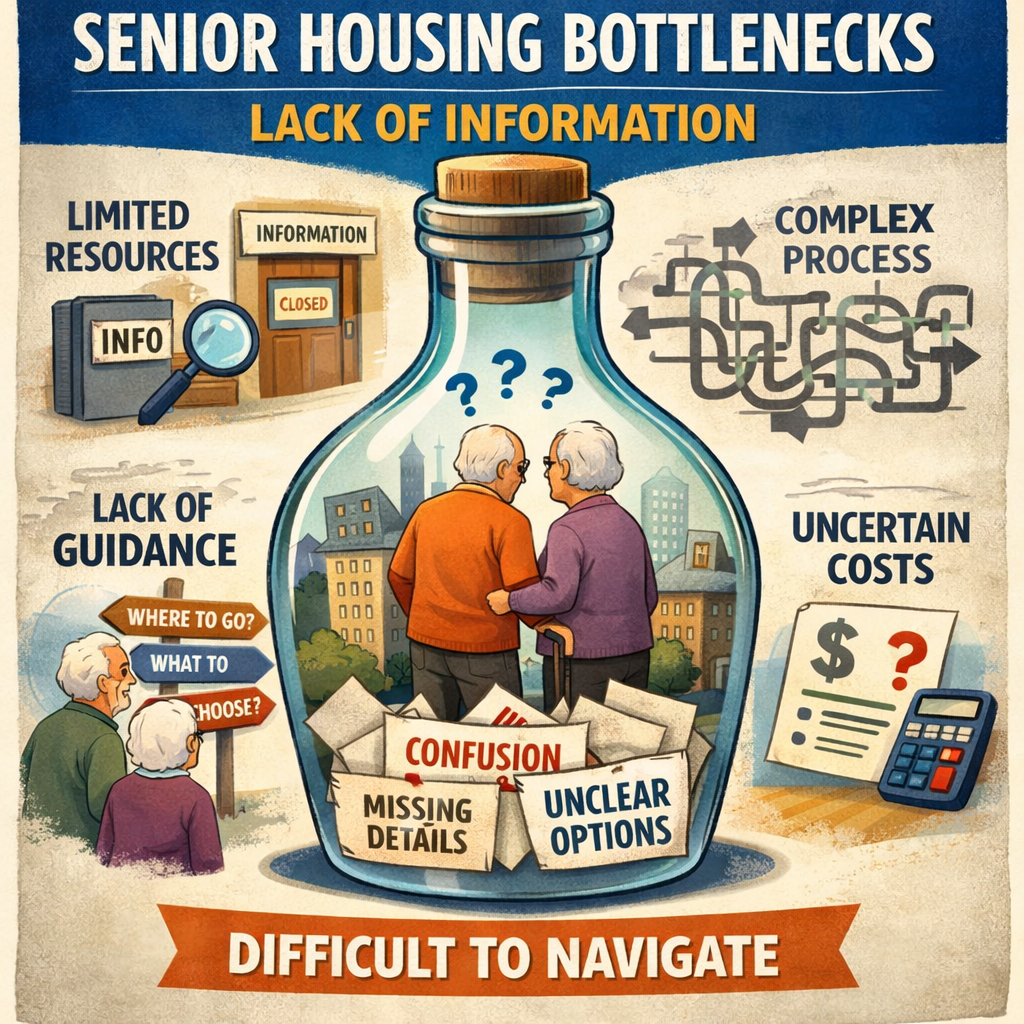
When a family says yes, they are not finished. They are entering a maze. The home has to sell, or not. The equity has to be understood. Decades of belongings have to be sorted and moved. The right level of care has to be confirmed, and escrow has to close. A dozen professionals touch the family along the way, and most of them never speak to one another. Every handoff between them is a place where families stall, get confused, or quietly give up. Those handoffs, Kelly says, are what the majority of the 317 days are actually made of.
The order of operations starts with the senior
One of the most common mistakes Kelly points to is that the process tends to orient around the adult children. They are motivated and anxious, so the transition gets built around their timeline. She argues that this is backwards. The order of operations in a senior transition should start with the senior if they are lucid and able to make their own decisions. When a community rushes the senior, it does not simply risk that one resident. It risks every referral that senior and family would have generated over the years that follow. Rushing, in her framing, is not speed. It is how a community loses the same client twice.
The same discipline applies to the finances. Many of the costly mistakes families make happen because the home sale gets triggered before anyone understands the full picture. Selling first and asking questions later can quietly remove options a senior never knew they had. Reverse mortgages are one example Kelly raises. They have changed significantly in recent years and are more useful than most families, and many professionals, assume. But that conversation only happens when someone slows the process down enough to sequence it correctly, and that role rarely exists inside a community's sales team.
Who controls the decision before the community enters
A statistic from the episode underscores the point. Roughly 64 percent of senior living move-ins come from unpaid referrals, not paid placement or ad spend according to Jerry Vinci.
That reframes where the decision is actually shaped. Long before a family contacts a community, they are already talking with a Realtor about the house, a lender about the money, and an estate sale professional about the belongings. Those conversations influence the outcome well before a community joins them.
Kelly notes that many communities build relationships with placement agents and caregivers and then stop there. Both matter, but they enter the journey late. A community that only knows the professionals at the end of the process is overlooking the ones who guide its beginning.
Fixing fragmentation with coordination
A coordination problem cannot be solved with more marketing. It is solved with coordination, and that is the premise behind Seniornicity.
Seniornicity connects the providers a senior actually moves through, including Realtors, lenders, property managers, senior placement advisors, estate sale and move management companies, and non-medical caregivers, into a single vetted and trusted network. Rather than a directory of strangers, it functions as a coordinated system where the professionals serving a family are aware of one another, aligned on the order of operations, and working the transition as one process instead of six disconnected ones.
When the sequence has an owner, the timeline begins to compress. The home sale is timed correctly instead of triggered in a panic. Financial options are understood before doors close. The senior moves at a pace built on trust, which protects both the resident and the referral stream that follows. Families stop slipping through the cracks, because the cracks are the handoffs, and coordination is what closes them.
What it means for operators
 For senior living operators, the takeaway is practical. A stalled occupancy number is often not a lead-volume problem but a coordination problem hidden inside the sales cycle. A stalled family is not necessarily a lost one, and the more useful question is which handoff they got stuck in and who was meant to catch them.
The advice that runs through the conversation is to build a wider network than placement and care alone, to know the Realtors, lenders, estate sale professionals/move managers and transition professionals who are in the room first, and to treat a family's yes as the start of the work rather than the end of it. Yes is not a move-in. It is the beginning of the part of the journey that, for most communities, no one owns.
Hear the full conversation on the From Leads to Leases podcast, episode 106, "Why Families Say Yes and Still Don't Move In," featuring Seniornicity founder Simone Kelly with host Jerry Vinci of CCR Growth. To learn how Seniornicity connects trusted senior transition providers into one coordinated network, visit seniornicity.com.